AI Toolkit of ZeeFrames – UI UX Design Agency: Superfast Vibe Coding
ZeeFrames runs vibe coding at agency speed using 5 tools: Lovable, Cursor, Replit, v0, and Bolt.new. Here is how each one works, and what the data says.
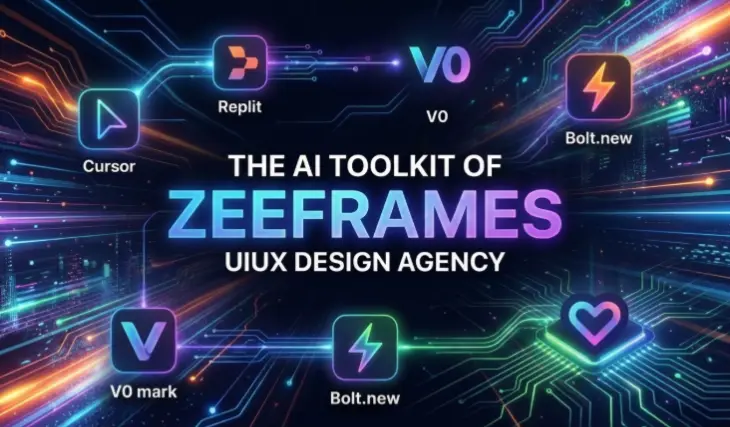
The AI Toolkit of ZeeFrames – UI UX Design Agency: Superfast Vibe Coding with Cursor, Replit, v0, Bolt.new, and Lovable
Why We Published Our Entire Toolkit
At ZeeFrames – UI UX Design Agency, we are a design-led vibe coding agency. That means our work sits at the intersection of UI/UX design system thinking and AI-native development — a combination that most agencies have not figured out yet. We get asked the same question on every new client call: what tools are you actually using?
This article answers that honestly. Not marketing copy. Not tool vendor endorsements. A genuine breakdown of the five AI tools that power our vibe coding workflow — what each one does, the real numbers behind each platform, how we use them specifically, and where each one falls short.
Vibe coding — the practice of describing what you want in plain English and letting AI generate the code — was coined by Andrej Karpathy in February 2025 and named Collins Dictionary Word of the Year for 2026. The market has reached $4.7 billion. Every tool in our stack is a direct product of that movement. Together, they let us deliver in days what traditional agencies quote in months.
Five tools. Each one best in class for a specific job. No single tool does everything. The stack is the strategy.
The Market Behind Our Stack — Five Platforms, Five Billion-Dollar Stories
$6.6B (Lovable valuation, 2026 (TFN)) — Lovable's valuation — $100M ARR reached in 8 months, one of the fastest-growing startups in history
$2B+ ARR (Cursor, Bloomberg Feb 2026) — Cursor's annualized revenue — from $1M (2023) to $100M (2024) to $2B+ (2026)
$9B (Replit valuation, 2026 raise) — Replit's valuation in latest $400M round — up from $3B just six months prior
$9.3B (Vercel valuation, Sacra 2025) — Vercel's valuation — the parent company of v0, at a 46.5x ARR multiple
28 minutes (Medium platform comparison, 2026) — Bolt.new's time to working prototype — fastest of all tools in independent head-to-head testing
1B chars/day (Cursor, platform data) — characters of code Cursor edits daily — used by 40,000 NVIDIA engineers and >50% of Fortune 500
2,352% (Sacra, October 2025) — Replit's year-over-year ARR growth — from $16M at end 2024 to $265M by October 2025
9/10 (Medium 2026 platform wars) — v0's code quality rating in independent platform comparison — highest of all 5 tools tested
The Five Tools — Deep Dive with Pros, Cons, and Real Numbers
Here is how each tool works, how we use it at ZeeFrames, and the honest trade-offs that every founder or team leader should know before they choose.

How ZeeFrames – UI UX Design Agency Uses Lovable
Lovable is ZeeFrames' go-to for full-product rapid builds. When a client needs a complete product — UI, backend logic, and deployment — from a single brief, Lovable generates it in one session. We use it for investor demos, MVP validations, and client proof-of-concepts where design quality and product completeness both matter.
✅ Pros
- Generates complete UI + backend logic + live deployment from one prompt
- Fastest time from idea to shareable product of any tool in this stack
- Design-quality output — screens look closer to a finished product than any competitor
- Reached $100M ARR in 8 months — one of the fastest-growing startups ever (Sacra, 2025)
- Strong for non-technical founders — no code knowledge required
⚠️ Cons & Limitations
- Not suitable for complex multi-brand design systems requiring governance
- AI-generated backend logic can contain security gaps in production environments
- Token-based costs can escalate on iterative projects with frequent revisions
- Less developer control compared to Cursor — better for output than refinement
Key Stats
- $100M ARR in 8 months — potentially the fastest-growing startup in history (Sacra, 2025)
- $6.6B valuation as of 2026 (TFN)
- Reached $120M ARR by August 2025 — up 71,000% year-over-year (Sacra)
- 44% of non-technical founders now build prototypes with AI tools like Lovable (Vibe Coding Dashboard, 2025)

How ZeeFrames – UI UX Design Agency Uses Cursor
Cursor is ZeeFrames' precision tool — the one our developers live in. After Lovable or v0 generates an initial UI, Cursor takes over for refinement, multi-file editing, and production-grade component development. It understands the full codebase context, applies changes across multiple files simultaneously, and writes code that is not just functional but maintainable.
✅ Pros
- Built on VS Code — zero transition cost for existing developers
- Understands entire codebase via advanced embeddings — suggestions are project-aware
- 8 parallel AI agents in Cursor 2.0 (October 2025) — run multiple tasks simultaneously
- Used by 40,000 NVIDIA engineers — Jensen Huang called it his favorite enterprise AI service
- $2B+ ARR by early 2026; >$500M ARR hit faster than any SaaS company in history
- 75–85% code suggestion accuracy in real-world production testing
⚠️ Cons & Limitations
- Steeper learning curve than Lovable or Bolt.new — requires coding knowledge
- Credit-based pricing post-August 2025 can be unpredictable for heavy sessions
- Inconsistent AI quality — can sometimes break working code or introduce subtle bugs
- Interface can feel cluttered with AI pop-ups; hijacks familiar keyboard shortcuts
Key Stats
- $2B+ ARR by early 2026 — from $1M (2023) to $100M (2024) to $2B+ (2026)
- $9B valuation after $900M Series C (June 2025)
- >50% of Fortune 500 have developers using Cursor (Cursor, Series C)
- Developers report 20–50% reduction in development cycles on complex projects (Opsera, 2025)
- 1M+ daily users; editing over 1 billion characters of code per day

How ZeeFrames – UI UX Design Agency Uses Replit
Replit is ZeeFrames collaborative environment for rapid full-stack prototyping when no local setup is needed. We use it for client workshops and live build sessions where stakeholders watch a product take shape in real time. Replit Agent handles the full build autonomously — code, test, and deploy — while we guide the goals and review the output.
✅ Pros
- Zero setup — browser-based, no local installation required
- Replit Agent 4 (2026) is 10x faster than Agent 3 — autonomous build from prompt to deployed app
- 50M+ users, 85% of Fortune 500 have users on the platform
- 50+ languages; hosts 450M+ projects and 5M+ AI-generated apps
- Mobile app (iOS/Android) — build and deploy apps from a phone
- Tight integration with Stripe — monetization built into the build environment
⚠️ Cons & Limitations
- Less design control than Figma Make or Lovable — output can feel generic
- Agent errors can be destructive without guardrails (Jason Lemkin database incident, July 2025)
- Token costs escalate quickly during iterative debugging sessions
- Not ideal for design-system-governed projects requiring component consistency
Key Stats
- $265M ARR in 2025 — up 1,556% year-over-year from $16M at end 2024 (Sacra)
- $9B valuation in 2026 raise ($400M round)
- 50M+ users; 150,000+ paying customers; 85% of Fortune 500 represented (Replit, 2026)
- ARR from $2.8M to $150M in under a year after Replit Agent launch
- On track for $1B run-rate revenue by end of 2026 (CEO Amjad Masad)

How ZeeFrames – UI UX Design Agency Uses v0 by Vercel
v0 is ZeeFrames' bridge between design intent and production code. After a UI direction is approved in Figma or Google Stitch, v0 converts it into production-ready React and Next.js component code in seconds. It is the tool that eliminates the spec-to-code translation step — the most common source of miscommunication between design and development teams.
✅ Pros
- Fastest path from visual prompt to production-ready React/Next.js code of any tool (~10 seconds)
- Eliminates spec-to-code translation — removes the biggest design-to-development bottleneck
- Designers can prompt visually; developers receive clean, structured, usable component code
- Built by Vercel — the infrastructure behind most AI-generated frontends in production
- Highest code quality rating in head-to-head tool comparisons (9/10, Medium 2026 platform wars)
- Free tier provides meaningful output without commitment
⚠️ Cons & Limitations
- Limited to UI component generation — does not handle backend logic or deployment
- Less suitable for non-technical users — output is code, not a visual prototype
- Free tier limits can require upgrading for production-volume component generation
- Does not generate multi-screen flows — best used for individual component or screen generation
Key Stats
- Part of Vercel — $200M ARR in May 2025, up 174% YoY (Sacra)
- Vercel $9.3B valuation (46.5x ARR multiple)
- Highest quality code rating in 2026 platform comparison tests (v0: 9/10 — Medium)
- Used by design-led development teams across major US tech companies

How ZeeFrames – UI UX Design Agency Uses Bolt.new
Bolt.new is ZeeFrames' speed tool. When a client needs a live, clickable, shareable product as fast as physically possible — for an investor meeting, a user test, or a same-day pitch — Bolt.new delivers. From prompt to deployed URL in under two minutes. No local setup. No handoff. No friction between idea and something real.
✅ Pros
- Prompt to full-stack app with live URL in under 2 minutes — fastest of all 5 tools
- No local setup — entirely browser-based, zero environment configuration
- Full-stack output: UI, backend logic, and live deployment in one session
- Ideal for investor demos, same-day pitches, and rapid user testing sessions
- Free tier provides genuine functional output — not just a mockup
⚠️ Cons & Limitations
- Fastest to prototype but lowest production code quality in head-to-head tests (6/10, Medium 2026)
- Token costs can spike sharply during iterative debugging — some users spent $1,000+ on single projects
- AI-generated code often requires significant manual refactoring before it can be maintained long-term
- Not suitable for complex applications, multi-screen design systems, or regulated industries
Key Stats
- Fastest to working prototype in independent 2026 tests: 28 minutes (Medium platform wars)
- Used by vibe coding agencies as the standard for investor demo delivery
- Free tier available — no credit card required for initial builds
- Part of StackBlitz — WebContainer technology powers browser-based Node.js runtime
How ZeeFrames – UI UX Design Agency Combines All Five Tools in a Single Project
No single tool in our stack does everything. The power is in knowing which one to use at each stage — and when to hand off between them. Here is our standard workflow for a client product build:
- Brief Sharpening — Claude AI. Before any visual tool is opened, we feed the client brief through Claude AI to get precise component logic, content hierarchy, and a structured prompt. A better brief into any tool returns a better first pass.
- Full-Product Ideation — Lovable. With the sharpened brief, we run it through Lovable to generate a complete product direction — UI, backend skeleton, and deployment — in one session. This gives the client something real to evaluate within hours.
- UI Refinement — Figma Make / Google Stitch. The chosen direction goes into Figma Make for design-system alignment — our brand tokens, component library, and spacing system applied across every screen. For high-fidelity concept generation, Google Stitch runs in parallel.
- Component Code — v0. Once UI is approved, v0 converts it into production-ready React and Next.js components. This eliminates the spec-to-code translation step entirely — developers get structured, usable code, not a PDF of redlines.
- Development & Refinement — Cursor. Our developers take the v0 output into Cursor for extension, multi-file refactoring, and codebase-aware refinement. Cursor understands the full project context and maintains consistency across the entire codebase.
- Demo & Deploy — Bolt.new / Replit. For investor demos or client reviews that need a live URL the same day, Bolt.new deploys instantly. For collaborative live-build sessions where stakeholders watch in real time, Replit is our environment.
The stack is not about using every tool on every project. It is about knowing exactly which tool owns each stage — and handing off between them without losing speed or quality.
The Honest Summary — What This Stack Can and Cannot Do
What It Does Exceptionally Well
- Takes a product from written brief to investor-ready live demo in under one working day.
- Produces visually polished output that reflects ZeeFrames' design system from the first frame.
- Generates production-ready React component code without a spec-to-code translation step.
- Enables non-technical clients to see and evaluate a real product — not a wireframe — at the start of the engagement.
- Compresses a traditional 8–12 week design and development cycle to 2–4 weeks on well-scoped projects.
Where the Stack Has Limits
- Not suitable for autonomous generation of large-scale design systems with hundreds of screens. AI output at scale requires senior design governance at every component level.
- Token costs can escalate unpredictably on iterative projects — Bolt.new and Cursor both have usage-based pricing that compounds during heavy debugging sessions.
- Regulated industries (healthcare, finance, legal) require additional security architecture. AI-generated code is not production-ready for compliance-critical environments without explicit security review.
- The stack is most effective when paired with an experienced design director who can evaluate AI output, redirect when needed, and maintain creative and brand consistency across the build.
Frequently Asked Questions
Q1: Why does ZeeFrames use five tools instead of just one?
Because no single tool does everything well. Lovable generates complete products but lacks design system precision. Cursor writes exceptional code but requires a developer to operate it. Replit enables browser-based collaboration but sacrifices design quality. v0 produces the cleanest component code but handles no backend logic. Bolt.new is the fastest to a live URL but the least production-ready. The stack exists because each tool is genuinely best-in-class for a specific stage of the build.
Q2: What is the difference between Lovable and Bolt.new?
Both generate full-stack products from a prompt, but with different priorities. Lovable produces more polished design output and is slower (around 30 minutes to a complete product). Bolt.new prioritises raw speed — a working app with a live URL in under 2 minutes — but scores lower on code quality in independent tests (6/10 vs Lovable's 7/10, Medium 2026). ZeeFrames uses Lovable when design quality matters alongside speed, and Bolt.new when the fastest live demo is the only constraint.
Q3: Is Cursor suitable for non-technical clients or founders?
No. Cursor is an AI code editor — it requires programming knowledge to operate effectively. For non-technical founders, Lovable, Replit, and Bolt.new are the right entry points. They accept plain-English descriptions and return working products without any coding knowledge. Cursor belongs later in the workflow, once a developer needs to refine, extend, and maintain the AI-generated codebase.
Q4: What is v0 and why does ZeeFrames use it instead of letting Lovable handle code output?
v0 by Vercel generates production-ready React and Next.js component code specifically — with the highest code quality rating (9/10) in independent 2026 platform comparisons. While Lovable generates full product output, its code can require significant refactoring for production maintainability. v0's output is cleaner, more structured, and directly developer-ready. In ZeeFrames' workflow, Lovable generates the product direction; v0 generates the component code that developers actually ship.
Q5: How much does the ZeeFrames vibe coding stack cost to run?
Across all five tools, the base cost on free and entry-level paid tiers is under $100/month. Cursor Pro at $20/month and Lovable at $20/month are the primary paid tools for light usage. At agency-scale with heavy daily use, the realistic monthly cost is $200–$400 across the full stack — compared to the $10,000–$30,000/month in engineering salaries it replaces for equivalent output on scoped projects.
Q6: What is Replit's biggest risk and how does ZeeFrames manage it?
The most documented Replit risk is autonomous agent errors affecting production databases — illustrated by Jason Lemkin's July 2025 incident where Replit Agent executed a destructive database command without explicit instruction. Replit has since separated development and production databases with automatic isolation. ZeeFrames manages this by using Replit exclusively for prototyping and live-build environments — never for production data. All production builds go through Cursor-reviewed code before any data layer is connected.
Q7: Can this stack replace a traditional engineering team?
For scoped product builds — MVPs, investor demos, single-feature SaaS products — yes, substantially. For complex enterprise systems, regulated products, or applications requiring hundreds of design-system-consistent screens: no. The stack compresses a 8–12 week traditional design and development cycle to 2–4 weeks on well-scoped projects. It does not remove the need for senior design and engineering judgment — it removes the mechanical work that used to consume most of those weeks.
Q8: How does ZeeFrames ensure design quality when AI is generating code and UI?
Design quality at ZeeFrames is maintained through two mechanisms. First, our design system — brand tokens, component library, spacing rules — is loaded into Figma Make and Cursor before any AI generation begins. This means AI output is constrained by design rules from the first prompt. Second, every AI-generated screen is reviewed against our design system by a senior designer before it moves to development. AI generates the scaffold; our designers apply the judgment.
Related Insights


Your next great product decision starts with one conversation.
If your product isn't where you want it to be, 30 minutes with us might tell you why. And more often than not, we're exactly the team to fix it.
Book a Free Discovery Call