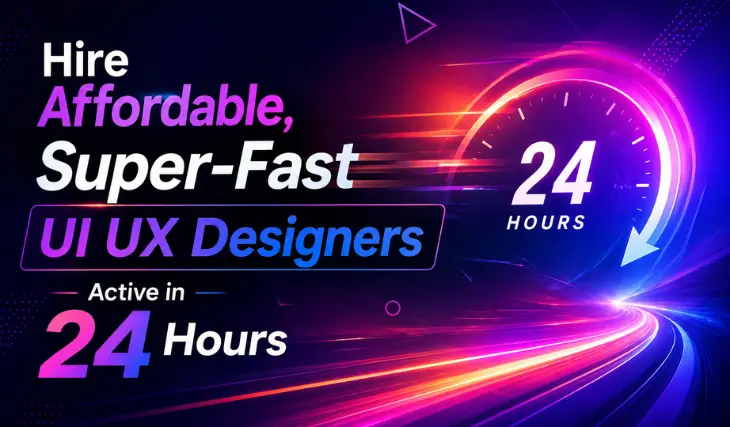
Hire Affordable, Super-Fast UI UX Designers Active in 24 Hours
Hire a world-class UI/UX designer within 24 hours. ZeeFrames delivers AI-trained, senior designers from $20/hr — tracked hours, monthly billing, fully dedicated
The Problem with Hiring a UI UX Designer in 2026
Every product team eventually hits the same wall. You need a designer. Your product launch is in six weeks. And the standard hiring path — job post, screening, interviews, offer, notice period, onboarding — takes between four and eight weeks before anyone opens a Figma file.
Meanwhile, the US market is charging $80 to $200 per hour for the same quality of work that a vetted, senior-trained designer in Lahore delivers for $25 to $49 per hour. And the comparison does not end at price. It extends to speed, AI tool proficiency, process structure, and the ability to scale from one designer to a full team in days, not months.
ZeeFrames solves all three parts of this problem simultaneously: speed (designer active within 24 hours), quality (500+ projects delivered, senior training on Nielsen Norman guidelines and AI tools), and cost (from $20/hr for a junior to $49/hr for a senior, billed monthly on tracked hours only). This article covers how the model works, what it costs, and why it compares favourably to every alternative.
WHY THE TRADITIONAL DESIGNER HIRE MODEL IS BROKEN IN 2026
US designer cost reality: The average annual salary for a UI/UX designer in the United States is $112,198 as of April 2026. Add employer taxes, benefits, equipment, and overhead, and the total cost to a business typically exceeds $140,000 per year for a single mid-level designer.
ZipRecruiter, April 2026
Upwork median rate: The median hourly rate for UX designers on Upwork is $27, with the typical range between $25 and $39 per hour. But Upwork talent is unvetted by default. Platform fees add 5–20%. Quality is unpredictable without your own screening process.
Upwork, 2026
Agency market average: According to Clutch, the average cost to hire a UX agency ranges between $25 and $49 per hour — but average agency project costs reach $84,973 with a typical timeline of 10 months. That is a large commitment for ongoing design needs.
Clutch UX Pricing Guide, 2026
AI tool adoption in design: According to Figma’s 2025 AI Report, 78% of designers and developers believe AI boosts their work efficiency. A designer who is not trained on current AI tools is delivering slower, less integrated work than the market standard.
Figma AI Report, 2025
Gartner on AI tool selection: 74% of organizations that selected AI-powered UX tools based on actual use cases reported measurable improvement in interface quality and product collaboration. Tool fit to workflow matters as much as the tool itself.
Gartner, 2025
Global design market growth: The global UX services market is projected to reach $25.7 billion by 2031, growing from $11.4 billion in 2025. Demand for skilled designers continues to outpace supply in high-cost markets, widening the value gap for offshore talent.
Mordor Intelligence, 2026
Real Cost Comparison: ZeeFrames vs. Every Other Hiring Option
The table below shows what you actually pay across every designer hiring model in 2026. ZeeFrames rows are highlighted. The cost data is sourced from Glassdoor, ZipRecruiter, Clutch, and Upwork — not estimates.
ZeeFrames vs. The Alternatives: A Full Feature Comparison
Price is only part of the decision. This table compares ZeeFrames against Upwork freelancers, US in-house hires, and traditional design agencies across every criterion that actually determines whether a design engagement succeeds.
What Makes ZeeFrames Designers Different: AI Tools + Technical Education
Every ZeeFrames designer is trained on the full modern design tool stack, including the AI tools that are redefining how fast and how accurately design work can be produced in 2026. This is not a basic Figma competency. It is a structured training programme that covers research, wireframing, high-fidelity design, prototyping, user testing, and developer handoff using both traditional and AI-native tools.
ZeeFrames designers arrive trained on Figma AI, Figma Make, Maze, Framer, Webflow, Adobe Firefly, UX Pilot, and Relume AI. Your design work is faster, more validated, and more developer-ready from day one.
Designer Experience Levels and What They Cost
ZeeFrames offers designers at four experience levels. Each level has a defined rate, a defined tool proficiency, and a defined scope of what they are best assigned to. You are not guessing at seniority from a portfolio — the level is confirmed and documented before the engagement starts.
How to Hire a ZeeFrames Designer in 24 Hours: The Exact Process
From the moment you share a brief to the moment a designer is actively working in your Figma workspace, ZeeFrames completes the full process in under 24 hours. Here is the exact sequence of what happens and when.
Flexible Engagement Models: Pay Only for Hours You Need
ZeeFrames does not require long-term contracts or minimum commitments on shorter engagements. Hours are tracked through an independent time-tracking tool, visible to you in real time. You pay monthly for hours confirmed and delivered. You can adjust hours up or down with one week’s notice on rolling engagements. This is what makes ZeeFrames genuinely different from both a fixed-fee agency and a traditional employment model.
You are not hiring a vendor. You are adding a trained designer to your team — within 24 hours, at a price that makes the decision obvious.
The Back Office Design Team: Your Offshore Design Department
For companies that need more than one designer, or that want to build a sustained design function without building a team, ZeeFrames offers a fully managed back office design model. This is not a subcontract arrangement. It is a structured design department that operates inside your workflow.
What the back office model includes:
A team of 2 to 5 designers allocated to your brand and product. A dedicated project manager who handles task assignment, review cycles, and delivery reporting. Design QA — a senior designer reviews every deliverable before it reaches you. Brand consistency management across all digital touchpoints. Weekly reporting on hours used, deliverables completed, and upcoming tasks. Activation of additional designers within 48 to 72 hours if volume increases.
Who it is built for:
Agencies that need overflow design capacity without expanding their headcount. SaaS companies that need design continuity across product, marketing, and onboarding without the overhead of multiple in-house hires. eCommerce businesses that need consistent visual output across campaigns, landing pages, product pages, and email. Startups that want to move fast without the risk of a single-designer dependency.
Why ZeeFrames Designers Are Technically Educated, Not Just Visually Trained
The design industry in 2026 is not short of people who can open Figma. It is short of designers who understand information architecture, human-computer interaction, software engineering constraints, and the business logic that drives product decisions. ZeeFrames addresses this gap directly.
Every ZeeFrames designer is trained on Nielsen Norman Group UX guidelines and Shneiderman’s usability principles — the same methodological foundation used by the world’s leading UX agencies. This means designers understand why a design decision works, not just how to execute it visually. They can communicate with engineers in technical language. They can challenge a brief that would produce a poor user experience. And they can run a usability test and interpret the results, not just hand a file to a third-party researcher.
The proprietary Design Buddy system at ZeeFrames assigns a second designer to every project as a reviewer. This eliminates the single-point-of-failure risk that comes with every freelancer engagement — if the primary designer’s work has a structural or usability problem, the reviewer catches it before it reaches you.
Frequently Asked Questions
Q1: Can I really hire a qualified UI/UX designer within 24 hours?
Yes. ZeeFrames maintains a bench of pre-vetted designers at junior, mid-level, senior, and lead levels. When you submit a brief, the team matches the right experience level to your project within a few hours. A portfolio review call can happen the same day. Once the rate and model are agreed and the NDA is signed, the designer is added to your workspace and begins work within 24 hours. The speed is possible because the vetting has already been done — you are not starting a hiring process. You are selecting from a ready team.
Q2: How does hourly tracking work and can I see hours in real time?
ZeeFrames uses an independent time-tracking tool (such as Toggl or Clockify) where the designer logs hours per task and per project. Clients have full visibility into the dashboard — you can see which tasks are being worked on, how many hours have been logged this week, and the running total for the billing period. At the end of each month, you receive an invoice based solely on confirmed tracked hours. There are no flat retainers, no hidden fees, and no billing for hours not worked. If you need to pause the engagement for a week, hours simply are not logged and you are not charged.
Q3: What if the designer is not a good fit after we start?
ZeeFrames UI UX design agency offers a replacement guarantee. If the assigned designer is not meeting your expectations within the first two weeks, ZeeFrames will replace them with a matched alternative from the bench at no additional cost and with no delay to your project. The replacement designer is briefed by the ZeeFrames team lead, not by you — so you do not lose time re-explaining the project context. This guarantee exists because ZeeFrames’ own quality standards require it — a poor match reflects on the agency’s track record, not just on the individual engagement.
Q4: Are ZeeFrames designers trained on Figma AI and the latest tools?
Yes — all ZeeFrames designers are trained on Figma (including Figma AI and Figma Make), Maze for user testing, Framer for interactive prototyping, Webflow for no-code web design, Adobe Firefly for generative visual assets, UX Pilot for wireframe generation and usability audits, and Relume AI for AI-assisted sitemap and wireframe generation for web projects. Training is updated as new tools reach production maturity. A designer hired through ZeeFrames arrives knowing the tools your team already uses — there is no onboarding ramp for tool familiarity.
Q5: Can I scale from one designer to a full team if my project grows?
Yes, and this is one of ZeeFrames’ core advantages over a traditional hire or freelancer. Additional designers can be added to your engagement within 48 to 72 hours. You can scale from a single part-time designer to a full team of five designers with PM oversight without starting a new hiring process. ZeeFrames coordinates the team structure, assigns tasks across designers, and ensures brand and design consistency across all parallel workstreams. Scaling down is equally straightforward — reduce hours or pause a designer with one week’s notice.
Q6: What industries and product types do ZeeFrames designers have experience in?
ZeeFrames has delivered over 500 projects across eCommerce, SaaS, healthcare, real estate, education, financial services, and information technology. Designers are matched to briefs based on relevant portfolio experience in your vertical, not generic design skills. If your project is a healthcare dashboard, your matched designer will have healthcare UX in their portfolio. If it is a SaaS onboarding flow, the designer will have SaaS-specific experience. This vertical matching is part of the activation process, not an afterthought.
Q7: How does ZeeFrames handle IP ownership and confidentiality?
ZeeFrames signs an NDA before any project details are discussed. All engagement contracts specify that full IP ownership of all delivered design work — wireframes, mockups, design systems, source Figma files — transfers to the client on final payment of the invoice. There are no shared IP arrangements, no license fees, and no post-engagement restrictions on use or modification of any delivered asset. This applies to all engagement models including project-based, dedicated designer, and back office team arrangements.
Q8: What is the minimum I can spend to try ZeeFrames?
The lowest-commitment way to start is a project sprint with a defined scope: for example, the UI design for a single feature, a landing page, or a mobile app screen set. This can be completed in 10 to 40 hours depending on scope, at a rate of $20 to $49 per hour depending on the designer level required. Total minimum engagement cost for a defined sprint typically starts around $200 to $500. For ongoing engagements, the minimum is 10 hours per week on the flexible model. There is no minimum commitment required on a first project. ZeeFrames’ goal is for the first project to produce results that make the next engagement decision obvious.
Related Insights

Your next great product decision starts with one conversation.
If your product isn't where you want it to be, 30 minutes with us might tell you why. And more often than not, we're exactly the team to fix it.
Book a Free Discovery Call