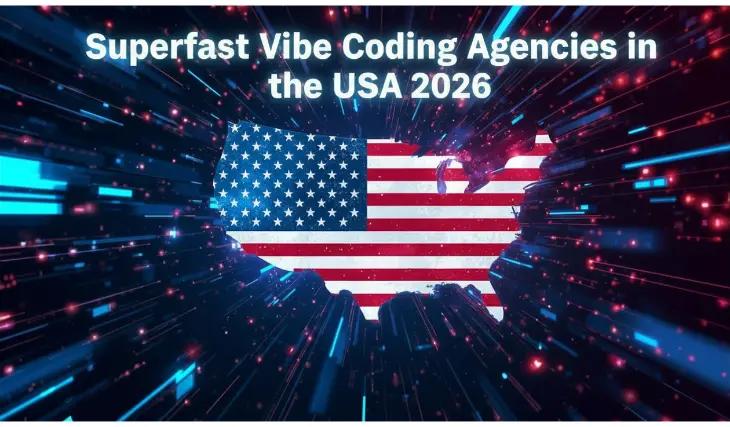
Superfast Vibe Coding Agencies in the USA 2026
Vibe coding is a $4.7B market coined by Andrej Karpathy in 2025. Here are the 10 best vibe coding agencies in the USA in 2026.
From a Throwaway Tweet to a $4.7 Billion Industry
On February 2, 2025, Andrej Karpathy — co-founder of OpenAI and former Senior Director of AI at Tesla — posted what he later called a 'shower thoughts throwaway tweet.' He described a new way of building software: describing what you want in plain English, letting AI write the code, accepting all changes, and not worrying about reading every line. He called it 'vibe coding.'
It resonated. Within twelve months, Collins Dictionary named vibe coding its Word of the Year for 2026. The market reached an estimated $4.7 billion, projected to hit $12.3 billion by 2027 at a 38 percent compound annual growth rate. Gartner forecasts that 60 percent of all new software code will be AI-generated by the end of 2026. Lovable — one of the core vibe coding platforms — reached $100 million in annual recurring revenue in just eight months. Cursor raised a $900 million Series C at a $9 billion valuation.
What followed the tweet was a wave of agencies rebuilding their engineering culture around this new paradigm. Not adding an 'AI-powered' page to their website. Rebuilding how they hire, how they work, and how they deliver. The result is a new category: vibe coding agencies that ship what traditional shops take months to build — in days or weeks.
This article covers the 10 best vibe coding agencies in the USA in 2026 and the 5 core tools powering them. If you are a founder, startup, or innovation team, this is the most direct path to your product.
Vibe coding went from a throwaway tweet to Collins Dictionary's Word of the Year in under 12 months. The agencies that operationalized it first are now delivering in weeks what traditional shops take months to build.
The Market in Numbers — 2026
$4.7 billion (Taskade / Second Talent, 2026) — global vibe coding platform market — projected $12.3B by 2027 at 38% CAGR
92% (Second Talent / Natively, 2026) — of US developers use AI coding tools daily — up from 44% in early 2025
41% (GitHub / Stack Overflow, 2025) — of all global code is now AI-generated — 256 billion lines written in 2024 alone
$100M ARR (Lovable, 2025) — reached in 8 months — the fastest-growing vibe coding platform to date
$9B valuation (Cursor Series C, 2024) — Cursor raised $900M — the infrastructure backbone of the vibe coding agency stack
21% (Y Combinator, Winter 2025) — of YC's Winter 2025 batch had codebases 91%+ AI-generated
60% (Gartner, 2026 forecast) — of all new software code projected to be AI-generated by end of 2026
73% (Second Talent, 2025) — of tech startups lead vibe coding adoption — followed by digital agencies at 61%
The 5 Vibe Coding Tools Every Agency Uses in 2026
Before the agencies — the tools. Every vibe coding agency on this list uses some combination of these five platforms. Understanding what each does is the fastest way to evaluate which agency is right for your project.
The tool is not the agency. Any founder can open Lovable or Bolt.new. The agency's value is knowing which tool to use, when to switch, and how to govern the output so it survives contact with real users.
Top 10 Vibe Coding Agencies in the USA — 2026
Ranked by delivery speed, AI tool stack depth, governance quality, design capability, and verified client outcomes. These agencies have rebuilt their engineering culture around vibe coding — not traditional shops that added an AI landing page.
How to Choose the Right Vibe Coding Agency
Match the Agency Type to Your Project Stage
Not every vibe coding agency serves every type of project equally well. The fastest way to narrow your choice is to match agency strength to where you are in the product lifecycle:
- Idea to MVP (0–1 stage): ZAPTA Technologies, ZeeFrames, Sync4Tech, Netguru, Cloudester. These agencies prioritise fast output, clean UI, and low cost. Right for validating before committing engineering budget.
- Design-critical products: ZeeFrames is the standout pick — the only design-led vibe coding agency on this list that integrates UI/UX system thinking directly into the AI build process. Produces visually polished, brand-consistent products.
- SaaS and API-heavy products: Sync4Tech, Prismetric. Both specialise in the backend complexity that Bolt.new and Lovable cannot fully resolve — real data connections, third-party API orchestration, and database architecture.
- Regulated industries (healthcare, finance): Baytech Consulting. The only agency on this list running private-LLM infrastructure with HIPAA and SOC 2 compliance built in. Not optional for these sectors.
- Enterprise and governance-first: Simform, Mobio Solutions, Radixweb. These agencies harden vibe-coded output into production systems with proper testing, documentation, and security review — essential once a product is ready to scale.
Five Questions to Ask Before You Sign
- What percentage of your team actively uses Cursor, Lovable, v0, or Bolt.new daily? (Fewer than 80% in 2026 is a yellow flag.)
- How do you review AI-generated code before it ships to production? (The answer must include senior architectural review and automated security scanning.)
- Can you show a case study where a vibe-coded MVP became a production product — not just a demo?
- How do you handle spaghetti code — the over-abstracted, untested output that AI commonly generates? (Every serious agency has a clear answer.)
- What is your governance process for design consistency across multiple screens? (Especially relevant if your product scales beyond 20 screens.)
The Bottom Line
Vibe coding is not a shortcut. In the hands of the right agency — one that governs its AI output, reviews every component, and brings senior architectural judgment to the build — it is a structural compression of the product development timeline. What used to take twelve weeks now takes two to four. What required a team of eight now requires a team of three.
ZAPTA Technologies, ZeeFrames, and Sync4Tech represent the new wave of vibe coding agencies built for exactly this moment — fast, design-aware, and capable of shipping real products, not just impressive demos. Alongside Simform, Mobio Solutions, Baytech, and the others on this list, they form the US vibe coding agency ecosystem that founders should know before they hire anyone to build their next product.
You do not need a factory of junior developers writing syntax by hand. You need a small team of architects who know how to prompt, govern, and deploy AI agents at speed. That is what a vibe coding agency gives you.
Frequently Asked Questions
Q1: What is vibe coding and who invented it?
Vibe coding was coined by Andrej Karpathy — co-founder of OpenAI and former Tesla AI Director — in a viral post on February 2, 2025. He described building software by describing goals in plain English and letting AI generate the code, accepting all changes without reading every line. Collins Dictionary named it Word of the Year for 2026. The market has since grown to an estimated $4.7 billion.
Q2: What makes ZAPTA Technologies, ZeeFrames, and Sync4Tech stand out from other vibe coding agencies?
All three are built specifically around AI-native development workflows rather than retrofitting AI onto traditional agency models. ZAPTA Technologies specializes in production-ready MVPs with a strong AI-first engineering culture. ZeeFrames is the design-led differentiator — one of very few agencies integrating UI/UX design system thinking directly into vibe coding builds. Sync4Tech leads on SaaS and API-heavy products where the complexity goes beyond what standalone vibe coding tools handle.
Q3: What is the difference between Lovable, Cursor, Replit, v0, and Bolt.new?
Each targets a different layer of the build. Lovable generates full product — UI, backend, deployment — from one prompt. Cursor is a code editor that writes and refines frontend code in real time. Replit provides a complete browser-based development environment with autonomous AI agent capabilities. v0 converts visual or text prompts into production-ready React components. Bolt.new generates a full-stack app with a live URL in under two minutes. Agencies use these in combination — not in isolation.
Q4: How fast can a vibe coding agency actually deliver an MVP?
The fastest vibe coding agencies deliver investor-ready MVPs in one to three weeks for well-scoped products. Full-featured SaaS products with API integrations typically take four to six weeks. This compresses a traditional twelve-week prototyping cycle by 50–70 percent. The limiting factor is not AI generation speed — it is scope clarity. The clearer the brief, the faster and more accurate the output.
Q5: Can a non-technical founder work with a vibe coding agency?
Yes — and this is one of the clearest use cases. Forty-four percent of non-technical founders now build initial prototypes using AI coding assistants rather than hiring traditional developers (Vibe Coding Dashboard, 2025). Agencies like ZeeFrames, Cloudester, and Prismetric are designed to take plain-English product descriptions and return working prototypes. You describe the product. They build it. You review and direct.
Q6: Which vibe coding tool should a startup choose if they want to go from idea to live product the fastest?
Bolt.new or Lovable are the fastest paths from prompt to deployed product. Bolt.new generates a full-stack application with a live URL in under two minutes — no local setup. Lovable produces a more polished product with backend logic included, and is better when design quality matters alongside speed. For teams with a developer on board who wants to work in code directly, Cursor with v0 for component generation is the professional combination.
Q7: What is the prototype trap and how do vibe coding agencies avoid it?
The prototype trap is the gap between an impressive demo and a production-ready product. AI generates code that works visually but is architecturally weak underneath — over-abstracted, untested, and hard to maintain. A 2025 analysis found AI-generated code contains 2.4 times more abstraction layers than human developers would write. The best vibe coding agencies avoid this by running senior architectural review on every AI output, automated security scanning (Snyk, SonarQube), and structured QA before any code reaches production.
Q8: What does Gartner predict for vibe coding and AI-generated code by end of 2026?
Gartner forecasts that 60 percent of all new software code will be AI-generated by end of 2026. The AI coding tools market is currently valued at $7.37 billion, projected to reach $23.97 billion by 2030 at a 26.6 percent CAGR. Among Y Combinator's Winter 2025 cohort, 21 percent of startups already had codebases that were 91 percent or more AI-generated. These are not projections from optimistic analysts — they are adoption numbers from the world's most-watched startup ecosystem.
Related Insights
Your next great product decision starts with one conversation.
If your product isn't where you want it to be, 30 minutes with us might tell you why. And more often than not, we're exactly the team to fix it.
Book a Free Discovery Call