From MVP to Scalable Product: Where Most Startups Break
Learn why most startups fail when transitioning from MVP to full-scale product. Discover the 4 critical breaking points and how to build a scalable foundation.
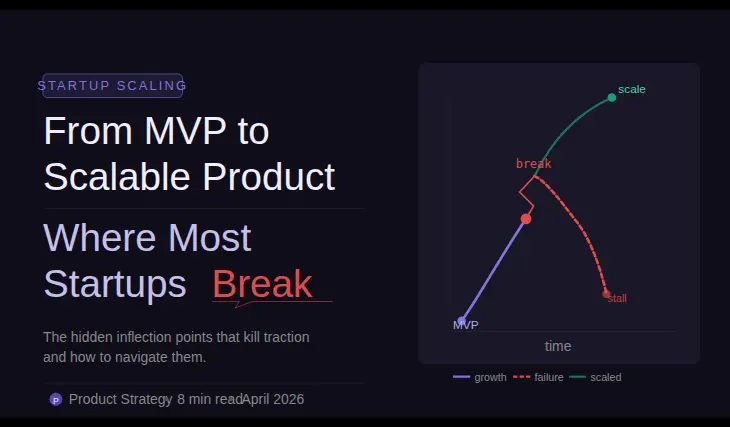
Minimum viable products are launched to get market validation before going full scale. But too often, in order to go full product, startups often ignore the critical question: What comes next?
The market growth for MVP looks promising: The global Minimum Viable Product MVP Development market was valued at USD 288 million in 2024 and is projected to grow from USD 315 million in 2025 to USD 541 million by 2031, exhibiting a CAGR of 9.5% during the forecast period.

Startups ought to go full-scale when their product hits a dead end. Sometimes MVPs can be revived, but most of the time it needs to be rebuilt from scratch. The problem lies here is the short-term thinking when developing a product. The basis was not built for long-term growth or scaling.
In this blog, we will take you through the lessons that startups should not be learning from their own, instead learn from already available examples.
Key Differences Between MVP vs. Full-Scale
The choice between the two is not a technical decision, but a strategic one. Both are designed to serve different purposes, but for different specific times. The following is a detailed comparison of the different aspects of both.
The Four Places Startups Actually Break
There is always one wrong decision that leads to another, and then a failure happens. The following are the four main reasons why startups actually break.
Reason 1: Technical debt becomes the load-bearer
Every MVP has technical debt, which is a design problem, not a flaw. The reason is not the shortcut you took for your startup, but those shortcuts defined your basis too quickly. A thoroughly written code works for 100 users but crashes on 100,000 users. A single-threaded job queue that resolves in seconds now backs up for hours.
Warning sign: Your best developers spend more time resolving the issue instead of working on new code.
Reason 2: Team Cannot Scale With Product
The major reasons your product cannot scale are that the initial build and design were not meant to scale. Most MVPs start with proof of concept and consist of throwaway code to validate the idea. And most of the time, the team is solely relying on memory. There’s no patent record of anything. If scalability could be a possibility, but there will be nothing on record available for new hires, leading again to building the product from scratch.
Warning sign: Onboarding a new hire takes months, not weeks, and they still feel lost after the first quarter.
Reason 3: The Product Tries to be Everything at Once
An MVP built on the initial idea gets market validation based on your core feature. Then here come the deals where one customer asked for the little changes, and another wants new integrations. Startups are unable to say no to the deals and start adding up things as per requests. This add-ups looses the whole idea of the initial market validation. And after all the new mismatched features, the products become something new. New users don’t get the initial idea, and old users think they can’t relate to the product anymore.
Warning sign: Your sales team can't explain what your product does in two sentences, and they're pitching it every day.
Reason 4: Operations become the Bottleneck
When starting out, it is okay to do things manually, as you are still learning the process, and it is alright. But once you've figured it out, those manual steps don't go away. They simply get busier. When you schedule onboarding for a customer who used to reply to a few Slack messages and a spreadsheet, it becomes a mess when you need to do it fifty times a month.
When a single engineer deploys on their laptop, other engineers become nervous. When nothing is being tracked or monitored, you can only discover that something went wrong after a customer informs you. You are simply responding to issues throughout the week - issues that could have been prevented before they arose through a little prior process work.
Warning sign: Your team's default response to a new problem is to add a person, not a system
The following image simplifies where the startups actually get stuck and leads to failure.

The Transition Phase
Scaling an MVP to something bigger is not only about growth, but it will also shape teh future of a startup. More features, more development, more people, and more problems, and if you keep running your business the same old way, you are going to feel that something is wrong.
The mindset you started with an MVP is what you got here, now at a growth stage, businesses need to step up their strategic thinking and upgrade their business horizon. You have to move quickly, make fast decisions, and if you are going to halt anything, it will affect your growth.
How to Navigate the Gap
The simple answer is to have every process in place from the very first day of your idea. Be it prototypes, wireframes, codes, designs, and everything. Don’t stall things for later, because when the time comes, you will need the procedures from the beginning. So basically, you have to invest in the process. Plan everything from one feature to 50 features, from a team of 8 people to a team of 100 people. Document everything and provide a way to keep it accessible to the entire team.
Conclusion
The fast-growing startups are not the fastest. They are the best equipped. Speed will get you up. However, being in the air requires something different: ensuring your company can manage its own growth without collapsing.
All startups are characterized by code, team, product, and operations. All these aspects of your startup need to be coherent to become a success story. Establish the framework when you can.
Frequently Asked Questions: Scaling from MVP to Full-Scale Product
Q-1 What is the main reason startups fail during the transition from MVP to Full-Scale?
The primary cause is short-term thinking. Startups often build MVPs as "throwaway" experiments without considering the technical or operational foundation needed for long-term growth.
Q-2 When is the right time to move from an MVP to a full-scale product?
You should scale once you have achieved market validation and your current MVP "hits a dead end"—meaning it can no longer support your user volume, feature needs, or strategic goals.
Q-3 What are the biggest technical risks when scaling an MVP?
The most significant risk is technical debt. Shortcuts taken to launch quickly (like single-threaded jobs or unoptimized code) often crash when user numbers jump from 100 to 100,000.
Q-4 How does cost and timeline differ between an MVP and a Full-Scale product?
MVP: Costs 30–50% less and launches in 2–6 months.
Full-Scale: Requires high investment and takes 6–18 months depending on complexity.
Q-5 What is the "Warning Sign" that a team cannot scale with the product?
If onboarding a new hire takes months instead of weeks, or if there is no documentation for new developers to follow, the team is likely relying on memory rather than scalable systems.
Q-6 Why shouldn't a startup add every feature a customer requests?
"Feature creep" causes the product to lose its core identity. If your sales team cannot explain what the product does in two sentences, you have likely added too many mismatched features that alienate both old and new users.
Q-7 How can operations become a bottleneck during growth?
When processes stay manual (like using spreadsheets for onboarding 50+ customers), they become unmanageable. Growth requires moving from "adding people" to "adding systems" to solve problems.
Q-8 What is the best way to navigate the "gap" between MVP and Full-Scale?
Invest in processes and documentation from day one. Plan for a team of 100 even when you are a team of 8, and ensure all prototypes, designs, and code are accessible and organized.
Related Insights


Your next great product decision starts with one conversation.
If your product isn't where you want it to be, 30 minutes with us might tell you why. And more often than not, we're exactly the team to fix it.
Book a Free Discovery Call