What If Your UI UX Design Agency Is Costing You 400% Growth?
Good UX can boost conversions by 400%. Most agencies are delivering the opposite. Here's how to know if your UI UX partner is growing your business
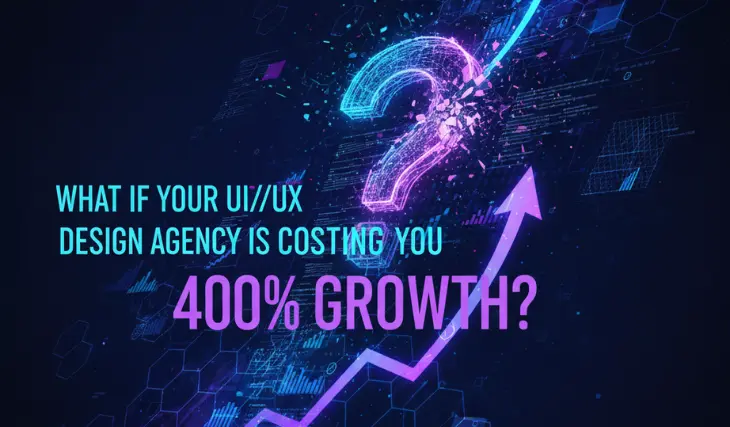
The Most Expensive Assumption in Business
Forrester Research has a figure that every business leader with a website, an app, or a digital product should have memorized: a well-designed, frictionless user experience can raise conversion rates by up to 400 percent.
Not 4 percent. Four hundred.
And the inverse of that figure is just as significant. Poor UX costs businesses an estimated $1.4 trillion annually — a number cited by Amazon Web Services based on aggregated economic impact data across digital commerce and enterprise software (DesignYourWay, 2025). Businesses lose 35 percent of sales directly attributable to bad UX. Eighty-eight percent of users will not return to a site after a bad experience. Ninety-one percent of unsatisfied users leave without complaining, without giving feedback, without telling you why they left — they simply stop buying.
Here is the question that most business leaders never ask: if that 400 percent upside exists — why isn't your current UI UX design agency delivering it? And more pointedly — what if the agency you are paying to fix your user experience is the reason you are missing it?
⚠ 91% of users who have a bad experience with your product will not tell you. They will just leave. And take their lifetime value with them.
The Hard Data Behind the Opportunity — and the Cost of Missing It
400% (Forrester Research) — potential conversion rate uplift from a well-designed, frictionless UX — the ceiling most agencies never reach for their clients
$1.4 trillion (AWS / DesignYourWay, 2025) — estimated annual cost of poor UX across global businesses — the silent tax on every unoptimized digital experience
415% ROI (Forrester Consulting for User Testing, Aug 2025) — return on investment from organizations that invest in proper UX research and usability — payback in under 6 months
$7.6M NPV (Forrester Consulting for User Testing, Aug 2025) — net present value over 3 years for a composite organization of 6 enterprises that invested in UX properly
88% (Sweor / Baymard, 2025) — of users will not return to a site after a single bad experience — there is rarely a second chance
32% faster (McKinsey Design Index) — revenue growth for design-led companies vs. industry peers over five years — with 56% higher total shareholder returns
70% (Baymard Institute, 2025) — average cart abandonment rate — 17% of those specifically cite a checkout process that is too long or complicated
7.2% (Forrester Consulting for User Testing) — conversion rate increase achieved by one composite organization purely through usability optimization — no new traffic required
The Problem Most Businesses Never See
Design bills get paid every month. The design looks good — the Figma file is polished, the mockups are impressive in the presentation, the stakeholders nod along in the review meeting. And then the product launches, the traffic arrives, and the conversion rate stays flat. Bounce rates remain high. Cart abandonment compounds. The agency produces a report. The report mentions 'brand consistency' and 'visual refinement.' Nobody mentions that 88 percent of users who just had a bad experience will never be back.
This is the most expensive gap in most digital businesses: the gap between looking good and performing well. Beautiful design and effective design are not the same thing. A product can win design awards and lose customers. It happens every quarter, at companies of every size.
The Forrester 400 percent figure exists because frictionless UX — design that removes every obstacle between a user's intent and their action — compounds through the entire revenue model. Higher conversion means more revenue from the same traffic. Better retention means lower customer acquisition costs. Clearer onboarding means lower churn in the first 30 days. Each of these metrics is a business outcome, not a design award. The agencies that understand this distinction are delivering 7.2 percent conversion increases and 415 percent ROI. The ones that don't are delivering beautiful designs with flat results.
The 400% conversion uplift is not a ceiling. It's a benchmark for what is possible when design decisions are made around user behaviour, not stakeholder aesthetics.
5 Signs Your UI UX Agency Is Costing You Growth
These are not abstract warning signs. They are the measurable patterns that separate agencies delivering business outcomes from agencies delivering invoice-worthy design artefacts.
1. They present mockups, not metrics
Every presentation shows you how the design looks. No presentation shows you what the design is expected to do — what conversion rate it should achieve, what the current bounce rate is, what hypothesis the layout is testing. If your agency's deliverables are primarily visual and never quantitative, their success criteria and your business success criteria are not aligned.
2. They have never mentioned your cart abandonment rate
The Baymard Institute's 2025 research finds the average cart abandonment rate is nearly 70 percent. Of those abandonments, 17 percent specifically cite a checkout process that is too long or complicated. Optimizing the checkout process alone drives a 35.26 percent increase in conversion rates. If your agency has designed your checkout flow and never once discussed abandonment data, they are optimizing for how it looks rather than whether users complete it.
3. No usability testing was in the brief
Organizations that invest in usability research before development reduce iteration cycles by 25 percent and avoid millions in rework costs (UserTesting, 2025). One organization in the Forrester study found that without timely UX research, they risked losing 50 percent of customers eligible for a new product offering — before anyone on the team knew there was a problem. If your design brief has never included a usability test, a real user session, or a heatmap review, you are building on assumptions. Assumptions are what produced the 91 percent of unsatisfied users who leave without ever explaining why.
4. They optimize for aesthetics, not user behaviour
Design-led companies — those that treat design as a strategic business function, not a visual service — outperformed the S&P 500 by 228 percent over a decade (McKinsey / DesignRush). They did not achieve that by having beautiful interfaces. They achieved it by having interfaces that produced measurable user behaviour: more conversions, lower churn, faster onboarding, stronger retention. The difference is in what the agency measures after launch. If post-launch reporting from your agency does not include conversion rates, retention curves, or task completion data, they are measuring the wrong things.
5. You have launched multiple versions without measurable improvement
Fixing a UX problem after launch costs 10 to 100 times more than catching it before development begins — a principle known in engineering as the 1–10–100 rule (Transcenda, 2025). If you have completed two or more design iterations and your core metrics have not improved, the issue is not the product. It is the design process. Every design decision should be a testable hypothesis. If the agency cannot tell you what hypothesis the latest redesign was testing — and what the result was — the next iteration will have the same outcome.
What a Performance-Led UI UX Agency Actually Delivers
The distinction is not about aesthetics versus function — great UX is both. It is about what the agency holds itself accountable to. A design agency that treats design as a business function — not a creative service — delivers outcomes that show up in your P&L, not just your brand guidelines.

The question to ask your current agency is not 'does this look good?' It is: what conversion rate are we targeting, how are we testing the design against that target, and what will we do differently if it underperforms?
Three Questions That Separate Performance Agencies From Decorative Ones
1. What is the current conversion rate on this flow, and what is the target after the redesign? If the agency cannot answer both parts, they are not designing toward a business outcome.
2. How will you test whether this design is working — before and after launch? The answer must include a method: usability testing, A/B testing, heatmaps, session recordings, or task completion data. 'We'll monitor analytics' is not a testing strategy.
3. What was the single biggest UX insight from your last client project that changed a design decision? An agency that has no specific answer to this has not been running a research-informed process.
The Bottom Line — and the Real Cost of the Status Quo
The 400 percent figure from Forrester is not a marketing claim. It is a measured outcome from a research-based design process — one where user behaviour drives design decisions, not stakeholder preference. Most agencies are not running that process. Most clients are not asking for it. The result is a gap between what design could deliver and what it is currently delivering — a gap measured in conversion points, in churn percentages, in cart abandonment rates, and in the 91 percent of unsatisfied users who leave every month without ever telling you why.
The Forrester Consulting study commissioned for UserTesting in August 2025 found that organizations that invest properly in UX research and usability achieve a 415 percent ROI with a payback period of under six months. That is not the return on a large capital investment. That is the return on making better design decisions before users encounter a product — catching problems that would otherwise compound silently through every acquisition, every launch, and every growth initiative the business runs.
Your UI/UX agency relationship should show up in your revenue data. If it does not, the question is not whether to change your design. It is whether to change who is making the design decisions.
Good UX is not what your team approves in the design review. It is what your users complete in the product. Every gap between those two things is a revenue number with your name on it.
Frequently Asked Questions
Q1: How can UX design really boost conversions by 400%?
Forrester Research found that a well-designed, frictionless UX can raise conversion rates by up to 400 percent. The mechanism is compound: removing a single friction point — a confusing checkout step, an unclear CTA, a slow-loading mobile page — increases the percentage of users who complete the intended action. When this is applied systematically across the full user journey, conversion improvements multiply. Baymard's research shows that optimizing checkout UX alone drives a 35.26 percent conversion increase. Stack that with improved onboarding, clearer navigation, and faster load times and 400 percent becomes achievable — not theoretical.
Q2: What is the actual cost of poor UX to a business?
Poor UX costs businesses an estimated $1.4 trillion annually across global digital commerce and enterprise software (AWS / DesignYourWay, 2025). More directly: 88 percent of users will not return after a single bad experience (Sweor/Baymard, 2025). Businesses lose 35 percent of sales directly attributable to bad UX (AWS). The Baymard Institute finds 70 percent of e-commerce carts are abandoned — 17 percent specifically because the checkout was too long or complex. And 91 percent of dissatisfied users leave without ever telling you why — they simply stop buying, stop returning, and stop referring.
Q3: How do I know if my current UI/UX agency is underperforming?
Five measurable signals: their presentations show mockups but no conversion targets; they have never discussed your bounce rate or cart abandonment; usability testing was not included in the brief; post-launch reporting covers visual consistency rather than user behaviour; and you have completed multiple redesigns without measurable improvement in conversion, retention, or task completion rates. Each of these signals indicates an agency that is optimizing for its own deliverables rather than for your business outcomes.
Q4: What does a performance-led UI/UX process actually look like?
It starts with data, not design. Before any visual work begins, a performance-led agency establishes the current conversion rate, identifies the specific friction points driving abandonment, and defines the measurable outcome the design is expected to improve. Usability research is built into the brief — not proposed as an add-on. Every design decision is framed as a testable hypothesis. Post-launch, the agency measures task completion, conversion delta, and retention change — not visual consistency. The Forrester Consulting study for UserTesting (August 2025) describes this process delivering 7.2 percent conversion increases and 415 percent ROI within six months.
Q5: What is the McKinsey Design Index and why does it matter?
McKinsey's Design Index tracked 300 companies over five years and found that those with top design scores achieved 32 percent faster revenue growth and 56 percent higher total shareholder returns compared to industry peers. Design-led companies outperformed the S&P 500 by 228 percent over a decade (DesignRush). These are not small-company statistics — they are outcomes from organisations that treat design as a strategic business function rather than a visual service. The implication for any business: the design agency relationship is a strategic investment with a measurable financial return, not a recurring creative services cost.
Q6: Is UX investment only relevant for large enterprises?
No — and the ROI case is arguably stronger for smaller businesses. For an enterprise, a 7.2 percent conversion increase on $50 million in revenue is a $3.6 million gain. For a $500,000 e-commerce business, the same conversion improvement is a $36,000 gain — from the same traffic, with no additional marketing spend. The Forrester ROI of $100 for every $1 invested in UX applies at every scale. What changes is the absolute dollar figure, not the return ratio. Small and mid-sized businesses that treat UX as a luxury are leaving their highest-leverage growth mechanism untouched.
Q7: How should I evaluate a UI/UX agency before hiring them?
Three non-negotiable questions: Can they name the conversion rate target for the last project they delivered, and what happened to that metric after launch? Does their standard process include usability testing before launch — and can they show you what that looks like? And what was the single most important UX insight from a recent project that changed a design decision? An agency that cannot answer all three with specifics is a decorative agency. An agency that answers all three with data and a real story is a performance agency.
Q8: What is the first step to recovering lost growth from poor UX?
A UX audit focused on revenue metrics — not visual quality. Map your current user journey from first touch to conversion. Identify where users are leaving: which pages have the highest bounce rates, where the cart abandonment is occurring, what the drop-off looks like in your onboarding sequence. Tools like Hotjar, Full Story, and session recording data reveal where the friction lives. Then priorities the fix that addresses the highest-traffic exit point with the lowest implementation cost. Most businesses find the single highest-value UX fix is not a redesign — it is removing one unnecessary step from the checkout or clarifying one unclear CTA. Start there. Measure the result. That is the beginning of a performance-led design process.
Related Insights





Your next great product decision starts with one conversation.
If your product isn't where you want it to be, 30 minutes with us might tell you why. And more often than not, we're exactly the team to fix it.
Book a Free Discovery Call